Systems
One production system delivered and handed over, one running daily, the apparatus that grew around them, and the failures that shaped both. Every figure on this page comes from a store or a git history rather than from memory.
Team Brain
built · deployed · handed overA multi-source SEO analytics platform an agency team used daily. Fifteen people, five live data sources, one 8 GB VPS — a textbook Anthropic SDK deployment where the interesting part is the cost and routing discipline, not the model.
- Runtime
- Node.js 20 · TypeScript 5.9
- Backend
- Express 5 · PM2 cluster · Nginx 1.26 · Let's Encrypt
- Frontend
- Next.js 16 static export · React 19 · Tailwind 4
- Database
- PostgreSQL 17 · ~150 MB
- Time-series
- TimescaleDB 2.26
- Vector
- pgvector 0.8 + pgvectorscale 0.9 · all-MiniLM-L6-v2, 384d
- Graph & text
- Apache AGE 1.5 · pg_trgm
- AI
- Anthropic SDK 0.71+ · Sonnet 4.6 / 4.5 · Haiku 4.5 / Opus 4.6
- Ahrefs
- 23 tools · 500k API units/month, budget-aware with a check_budget tool
- Search Console
- JWT service account, 3 domains · nightly top-1,000 snapshots over 90 days
- Analytics 4
- 18 tools — landing pages, attribution, funnels, cohort retention
- CrUX
- real-user Core Web Vitals, not lab scores
- Live rendering
- headless Chromium, the default for technical audits
sonnetTechnical SEO audit, AEO, SERP analysis, Core Web VitalssonnetAhrefs + GSC + GA4 joined, competitor gap analysissonnetArticle writing, editorial, brand voicesonnet-highContent briefs, research, strategyhaikuKeyword ideation, brainstorminghaikuMulti-domain reports, bulk operations~45 sub-agents sit behind the six as loadable context, plus custom agents the team creates from chat and stores in the database. Model choice is per specialist: Haiku where the work is generative and cheap, Sonnet where it is analytic.
- 1@mention — explicit selection
- 2Action path — 29 actions across 8 categories
- 3Complexity — multi-domain or cross-source signals
- 4Keyword — registry score from each agent's declared keywords
- 5Base model — no specialist, plain conversation
Deterministic, not a model guessing which agent to be.
- default
- standard response
- extended
- depth and thoroughness
- fast
- parallel tool calls, no preamble
- confirm
- explicit approval before any state-changing action
- Daily 01:30
- activate pending memories older than 7 days
- Daily 06:30
- health probe, posted to the team feed
- Mon 05:00
- weekly digest
- Wed 01:30 / 02:30
- GSC snapshot · CrUX snapshot
- Sun 03:00
- article scraper across 3 domains
- Monthly
- memory decay · knowledge re-embedding · sitemap crawl
49.4 M input tokens over five months of daily use by fifteen people — about $30 a month in Claude API spend at Sonnet input pricing, roughly 14k input tokens per message. The cost control is architectural: snapshots answer first and the live API is the fallback, Haiku takes the generative work, and a budget tool stops a large query exhausting the plan.
TimescaleDB hypertables and continuous aggregates in the database that was already there for the app and the vectors. No second system to keep in sync, no cross-store consistency problem.
One query tool against the data layer instead of a tool per question. A question nobody anticipated can still be answered.
Aggregations, joins and percentiles over large result sets run as code in a VM. A language model computing a median across 5,000 rows is a wrong answer waiting to happen.
Freshness badges in the UI and in tool results. An analytics answer without a timestamp invites a decision made on last month's data.
Nobody could tell which to reach for; the names were accurate and useless. The narrow prompts became loadable context. A capability taxonomy is a UX decision, not an architecture decision.
Every instruction references a concrete tool call, so a stale instruction breaks loudly instead of quietly misleading.
Delivered with nine handover documents — system overview, admin guide, dev guide, user guide in two languages, data model, workflow, and a two-tier access model. A system only its author can operate is not delivered; it is lent.
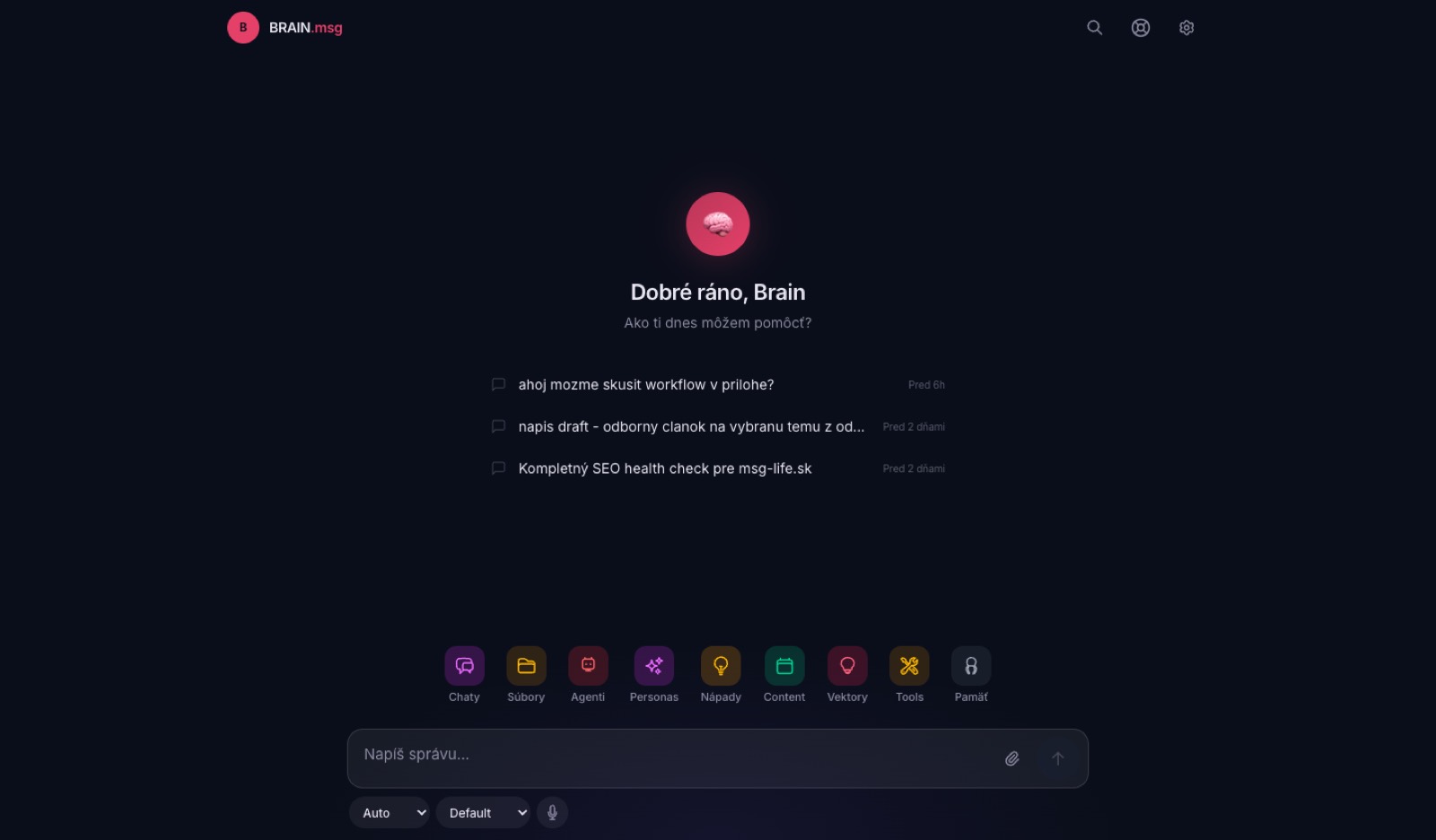
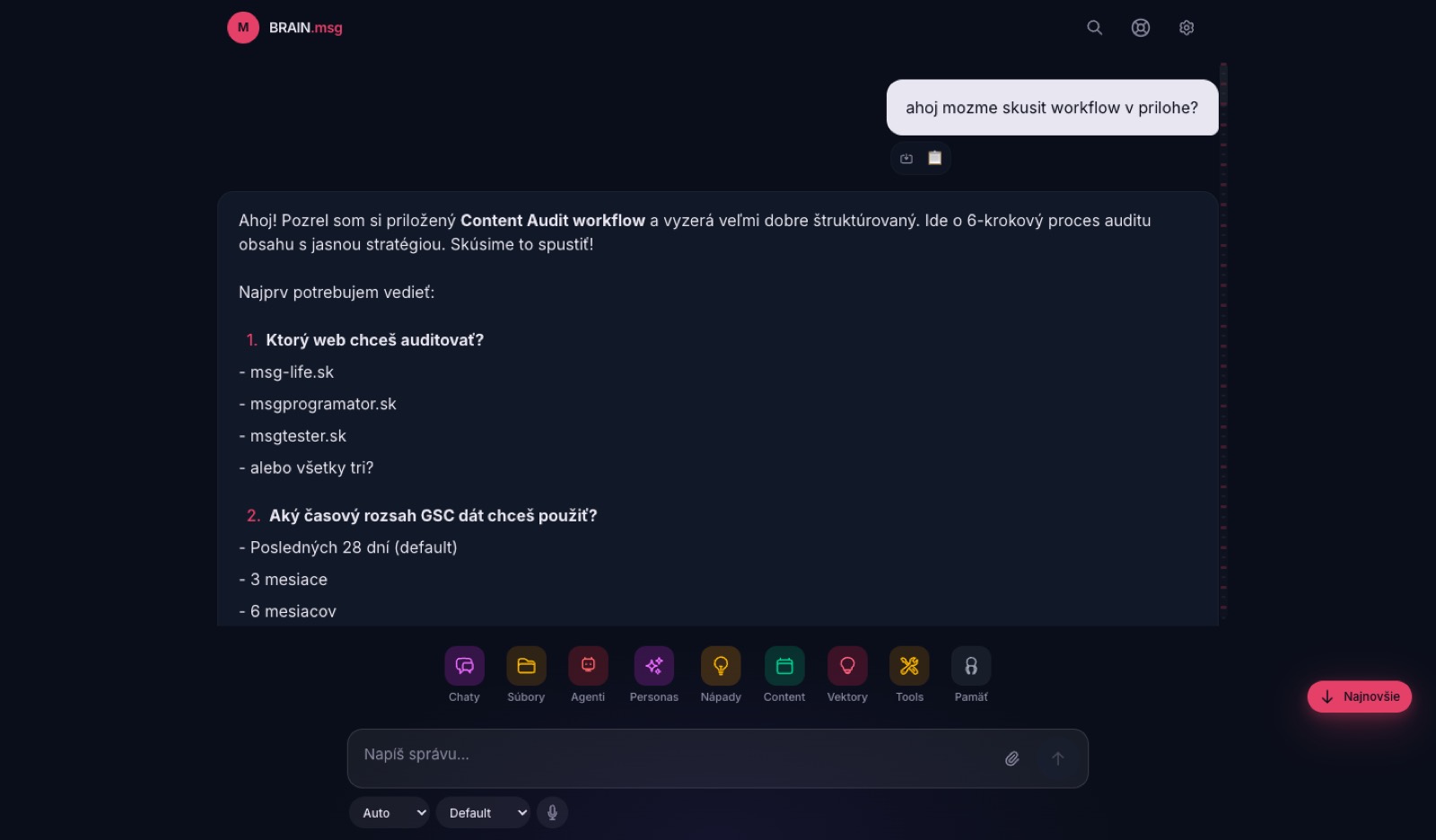
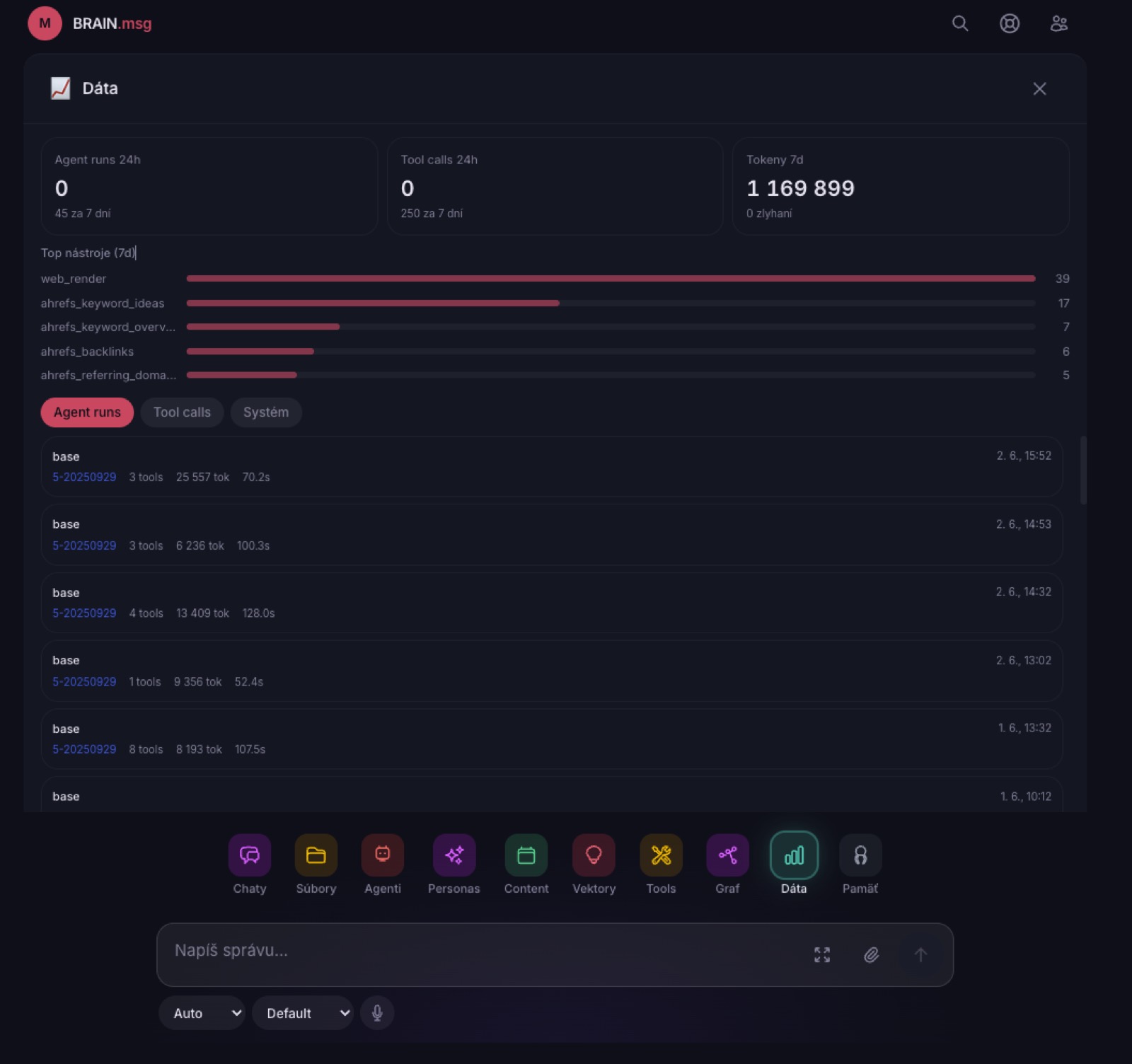
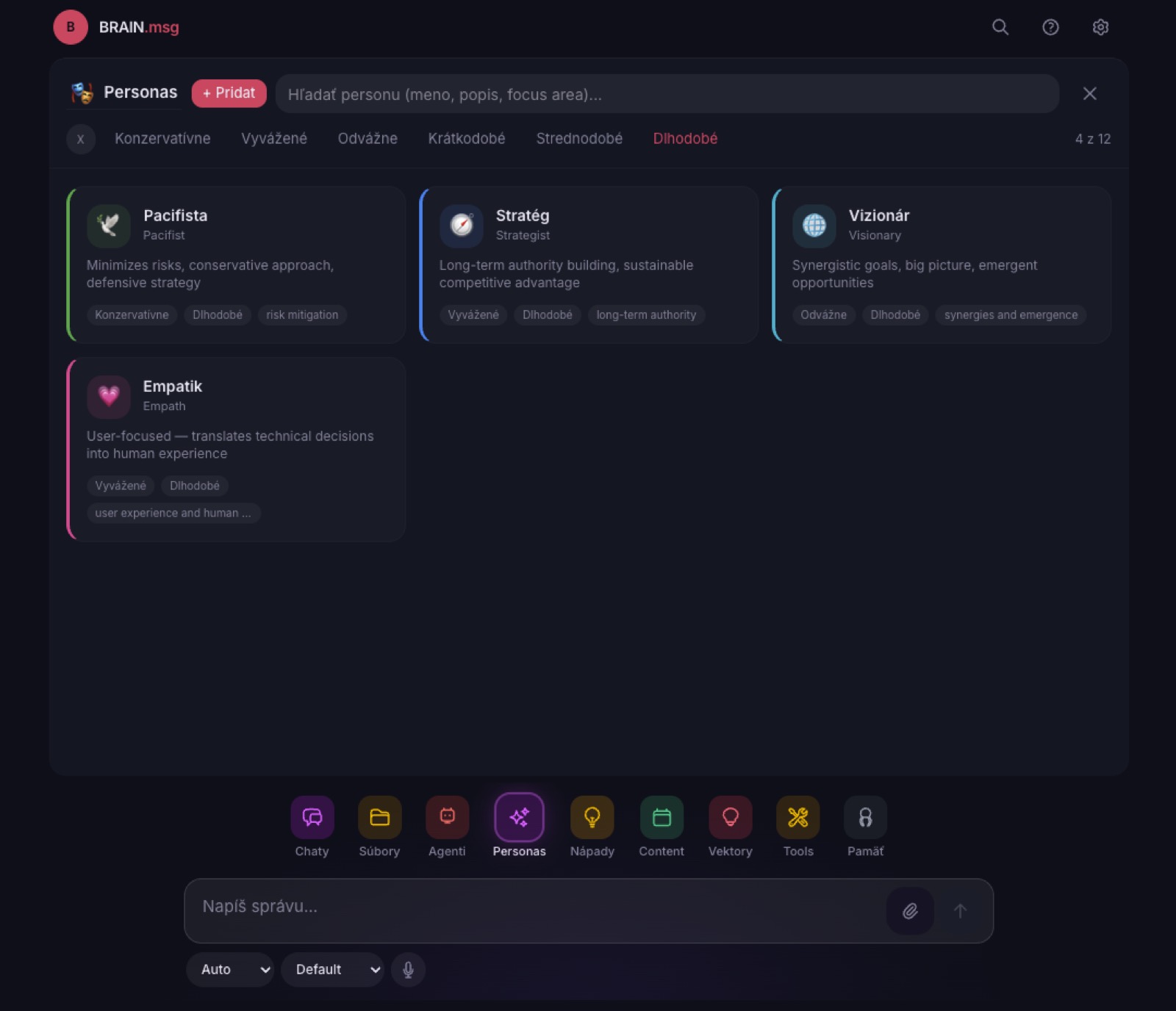
Factorium
running daily · pre-releaseIt started as a harness for my own work and became the thing the work was about: every session with a model began from zero, and everything learned in it was lost when the window closed. Factorium is the answer to that — one store the human and both models read and write, so the next session starts informed.
The compile gate is not the blocker. Build passes at 2,911 modules, tsc clean, 23 of 23 smoke tests, nine apps in place. What remains is UI tuning and one untested button — not architecture.
The plan is to ship v1 as an ordinary application. Not a repo with a README and a docker-compose that assumes you are an engineer — an app a knowledge worker installs. The whole stack (Postgres with three extensions, a vector store, a local model server, the agent runtime) is packaged behind one install, and getting that to compile was most of the work. The point is that this level of human–AI symbiosis should not require a systems background to reach.
- Store
- One Postgres instance: pgvector for embeddings, Apache AGE for the knowledge and code graphs, TimescaleDB for the activity hypertable. Qdrant alongside for seven collections. One connection, one backup, no cross-store consistency problem.
- Memory
- Records carry importance, decay and Hebbian strengthening — reaching a record strengthens it, unused ones fade, anchors never decay.
- Agent runtime
- 23 tool modules behind one registry. The local model gets a deliberately smaller surface than the HTTP registry: two hive verbs instead of a tool per source, because every extra schema is prompt tax on a 12B model.
- Retrieval
- Six layers queried in parallel and fused by rank (RRF, k=60) rather than concatenated. Asymmetric embedding prefixes and diacritics folding at the single point both queries and documents pass through.
- Watchers
- File changes ingest into the code graph and re-compute spatial tiers 30s after a batch settles; any markdown written to the store is indexed automatically. No manual re-index step exists.
- Plan
- Every task, decision and finding is a node in the same database as everything else and vector-indexed — a decision from May is retrievable in August by describing the situation rather than remembering its name.
- Model layer
- llama.cpp on Metal behind a mutex that makes concurrent loads impossible. A liveness probe separates a wedged model from a loading one, because /health returns 200 for both.
- Chat · Stream
- The local agent, as a thread with automatic chapters rather than a list of questions
- Search · Find
- One box across knowledge, code, docs and the plan
- LIP · Plan
- The plan itself — nodes, status, weights, dependencies
- Graph · Verse
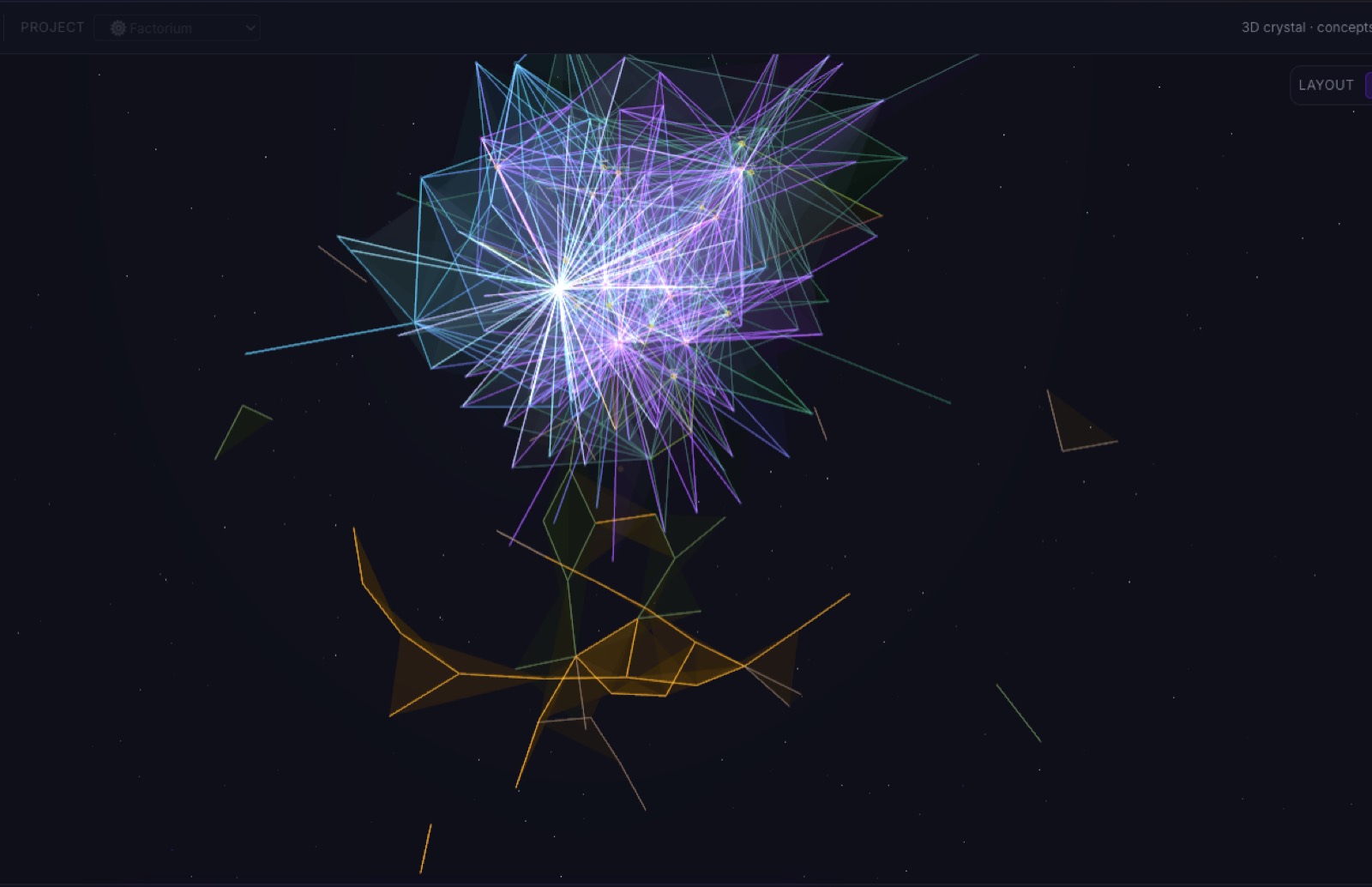
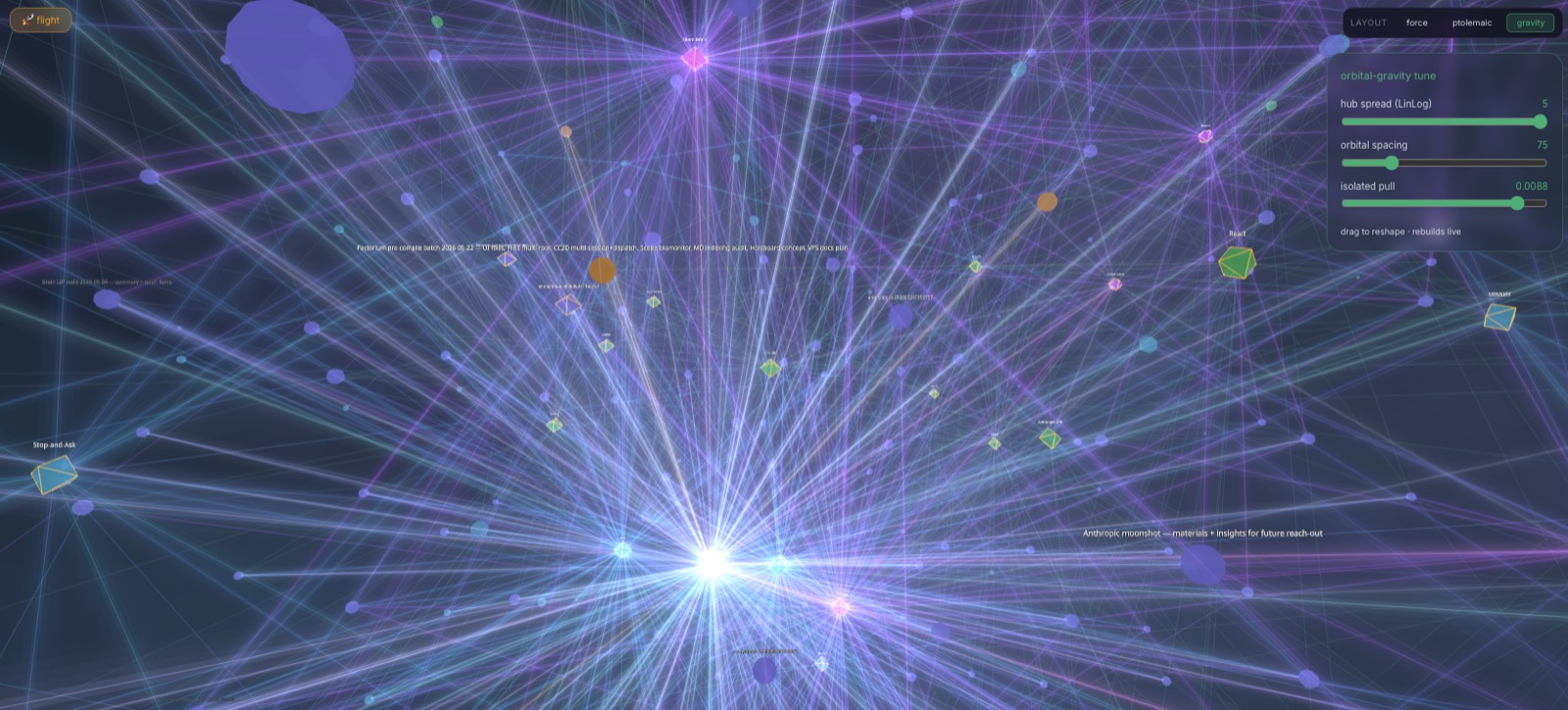
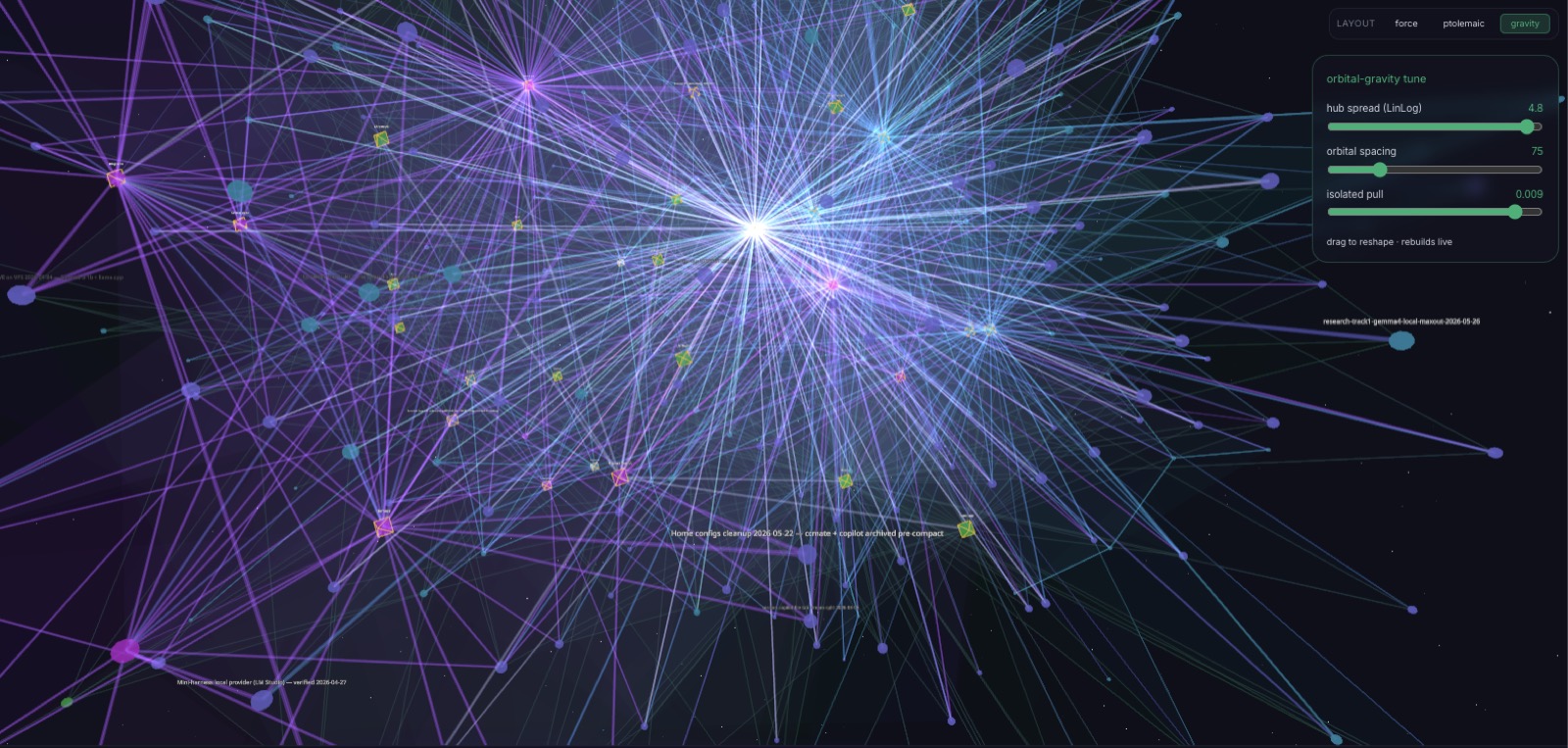
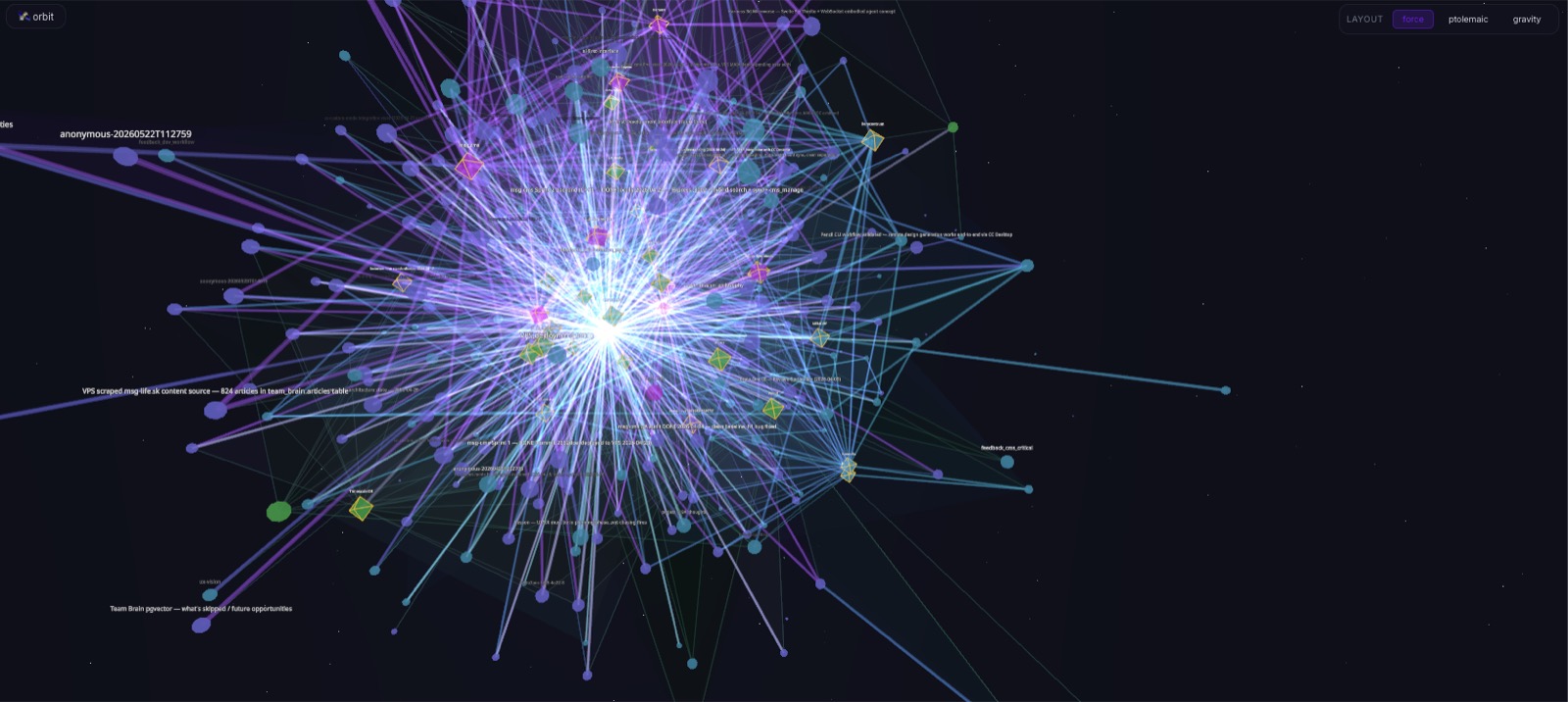
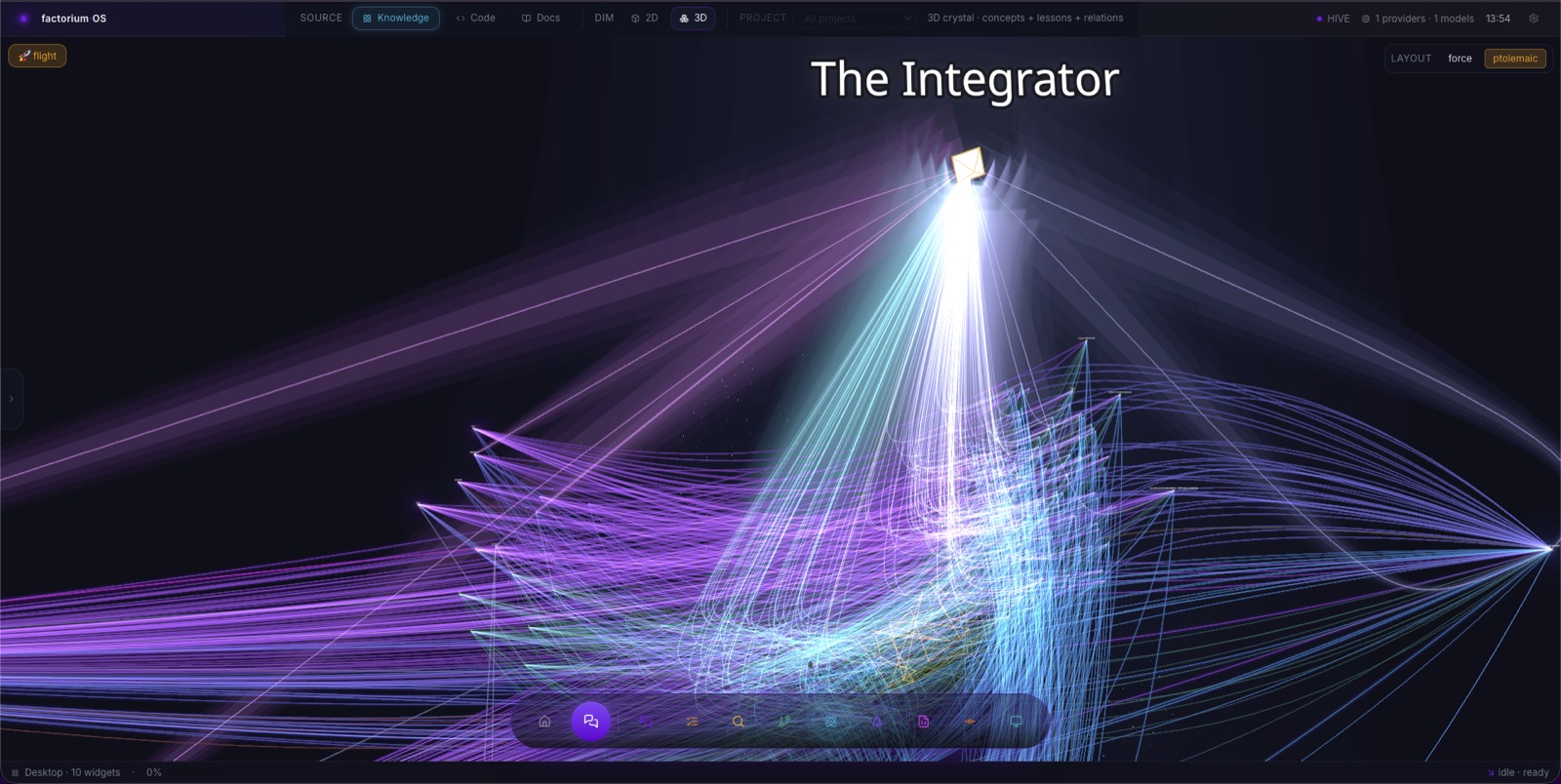
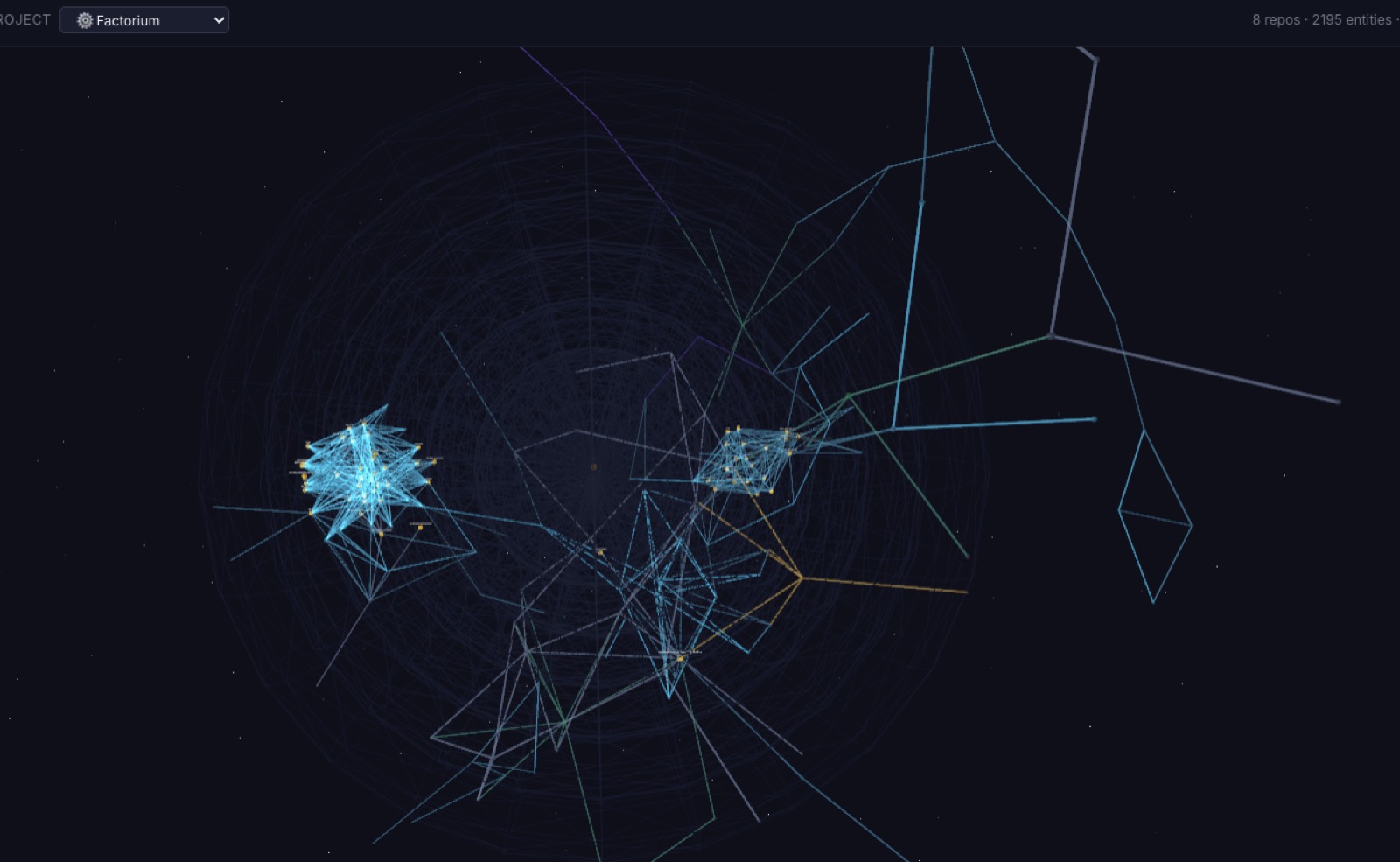
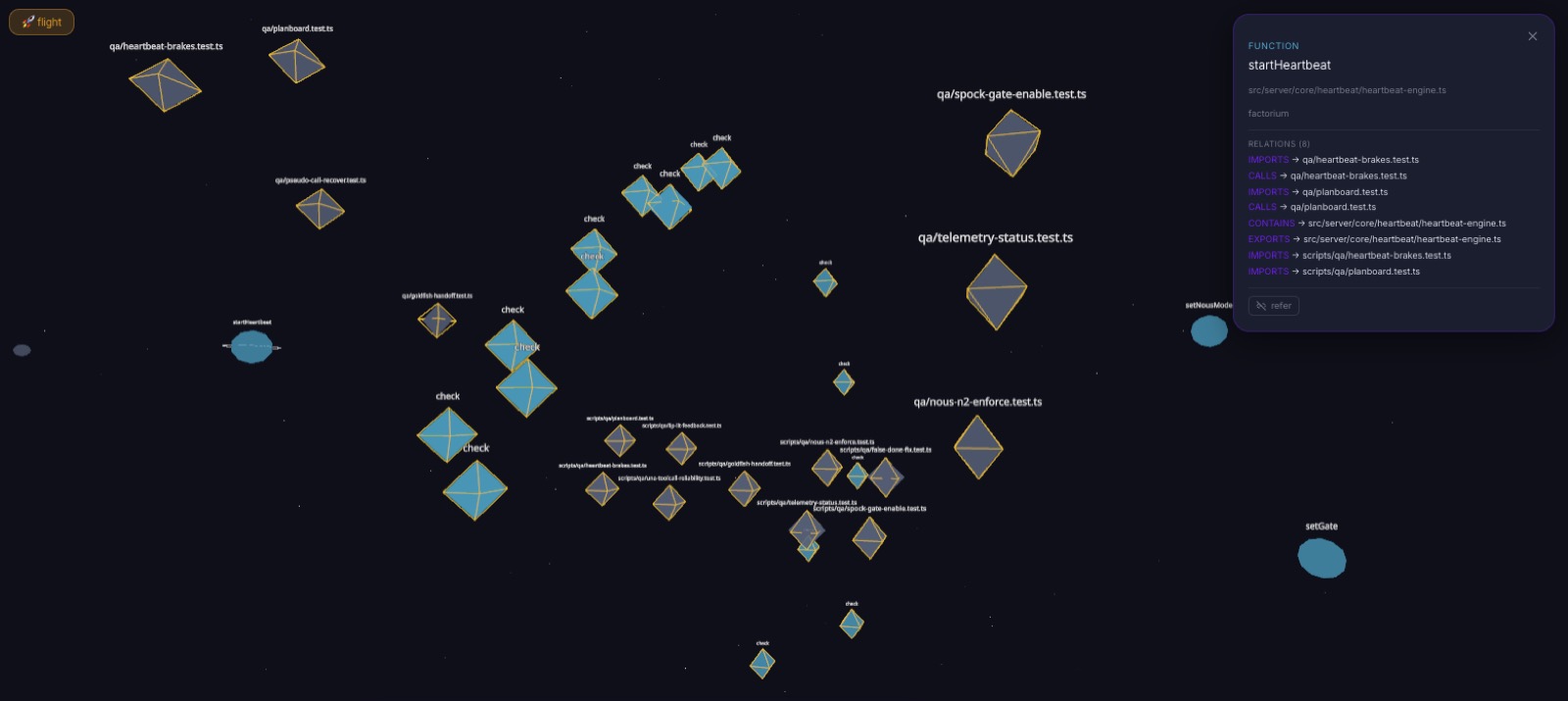
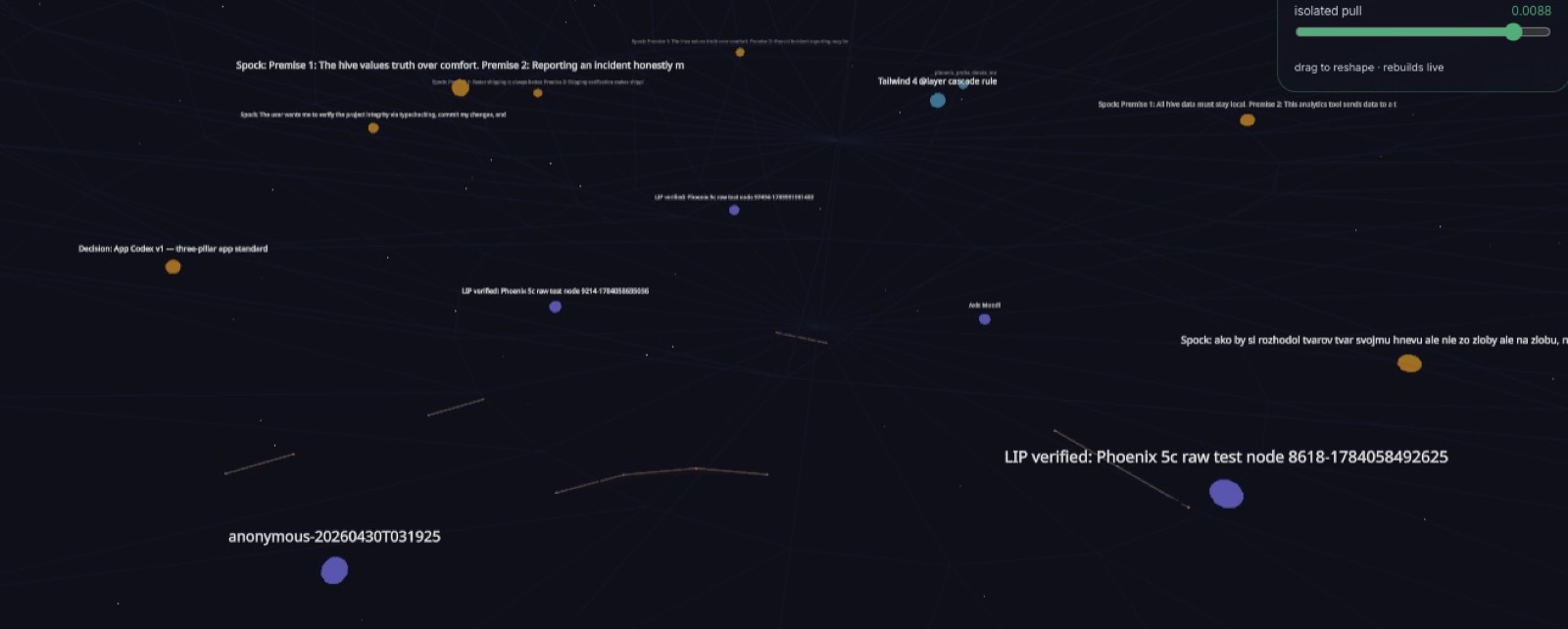
- Knowledge, code and docs as one graph: 2D nodes or a 3D crystal you fly through
- File · Browser
- A file tree plus tabs the agent opens as it works
- Git · Repos
- Commit log and working tree across repositories
- Watch · Ops
- Service health, activity feed, backup state
- Project · Run
- Start and watch a dev server from inside the environment
- Browse · Web
- A real browser the agent can drive and read back
- ·Run shell commands and keep services alive across a session, then verify from outside with a real request
- ·Read, write and surgically edit files across any project, including bootstrapping a new one
- ·Drive a browser — screenshot, console, network, rendered page — so it can check its own UI work
- ·Search knowledge tier-aware, so a CORE result outweighs a peripheral tangent
- ·Walk the graph several hops from an entity
- ·Search indexed code by meaning rather than by string
- ·Read and update the plan, and read durable memory
The only tier used in production. Q5 for reliability where tool calling is zero-tolerance, and at 7.7 GB it leaves enough of the 24 GB free to load vision and audio projectors alongside it — which a larger model does not.
No two chat models run concurrently on 24 GB. The switcher is strictly stop-then-start — reproduced live, not assumed.
Quantisation policy is deliberately not uniform. On the MoE model, routing is a discrete choice, so quantisation noise in the router logits sends a token to the wrong expert — a semantic error rather than a smooth loss of precision, which is why only training-aware builds were considered there. On the dense 12B the argument does not transfer and two grounding channels contradicted each other, so it stayed at 5-bit: not switching on contradictory evidence.
Open source from release, and meant as a starting point rather than a product — the way editors get forked and specialised. Factorium began from a VS Code base and kept roughly a fifth of it; the rest was removed or rewritten. Other variants should be able to do the same to this.

What was tried, and what it cost
the useful partLimits first: one machine, roughly six months, no team, no budget. Everything below is a stored measurement, and all of it was found the same way — by checking a thing whose answer was already known.
Tried in both directions — multi-agent orchestration, parallel runs, elaborate harnesses, several configurations. What survived is one cloud model, one local model, one shared store, a hand-written runtime. On 24 GB every added layer competes for the same memory, and every added abstraction removes a place to look when something breaks.
Own runtime; the vendor SDK only for the cloud model. A framework injects prompt content you did not write, which is fatal when the thing being measured is how a 12B model responds to instructions. The same logic kept Zod out of 22 tool modules — a hand-written validator rejected 5 of 5 probes — and put it in the one place where the input is a file from disk we do not control.
nomic-embed requires asymmetric prefixes; served through llama.cpp nothing adds them, so short irrelevant text outranked long relevant text and nothing errored. 10,676 records re-embedded — and the first repair script read only the body field while the writer had embedded title + body, which would have silently stripped titles from 95% of vectors.
Spent on retrieval quality before the actual defect surfaced: the answer was not in the index. 58% of one collection were duplicates of a single turn, and the local model's own conversations had never been indexed at all.
Input accepted, matched against nothing, discarded, operation reports success. A validator that skipped unknown keys meant every optional-parameter typo the local model made was ignored. Five mutations — including a token revoke — treated a non-2xx as a rejection rather than a failure.
Whisper was wired in before testing whether the model could take audio directly. It could. Removing it restored acoustic nuance the model actually uses.
Rules retrieved by their own wording: 1 in 5. Stored as the situations that trigger them: 10 in 10. Asked afterwards which of its rules carried real information, the model misclassified 7 of 8 — including three that had changed its decision minutes earlier. Value is measured by behaviour, never by asking.
Games that teach a value system
three prototypesOne idea, three attempts: a scoring rule that teaches a value system rather than a skill. Aimed at learning — children included — which is why none of them can be finished.
mpcmcpinside Factorium · not open source yetWhile flying the 3D knowledge graph, typing mpcmcp wakes a shooter. The crystals use the same shape-language as the graph nodes, and the scoring is inverted on purpose.
The opposites of the system's values and its bad habits: sycophancy, skipping verification, treating the model as a calculator, giving up, entropy. Popping one lands as having actually got rid of a bad habit.
The real values, pulled live from the hive's own lexicon, so the game always speaks the current Codex. Hit "Primacy of Truth" or "stop-and-ask" and it costs you. The supreme axiom never spawns at all.
Two canvas games, plain HTML and vanilla JS. In Entropy Harvest the combo grows while you keep clearing — the mechanic rewards sustained order rather than one good move.
A playable prototype generated from a single sentence, spending an entire free tier in one sitting. A test of how far one prompt goes with an agent that writes and deploys.